_edited.jpg)
Happy Lunar Year of the Fire Horse
As I wrote in my January newsletter, my husband and I cruised Asian seas during October and early November. We returned home for almost three weeks, then headed south to cruise through Central America. That cruise took us from Cozumel, Mexico to Guayaquil, Ecuador via the Panama Canal with additional stops at Costa Maya, Belize, Guatemala, Honduras and Costa Rica.
While I have a soft spot in my heart for all stops, I think Cozumel may have been the most fun. Our tour for the day took us to a restaurant where we learned how to make a variety of different Mexican salsas, guacamole and margaritas, and then we danced . . . salsa!
Two lovely young ladies (one Mexican and the other Venezuelan) taught us how to make a spicy salsa, a very spicy salsa, guacamole (using a portion of whichever spicy salsa we preferred) and a fruit salsa. As we crushed and mixed and squeezed ingredients, we also sampled the margaritas we made. I’m not a fan of margaritas, preferring instead a good Scotch whiskey, so I opted for cold, hibiscus tea, but only after sampling our margarita creations.


By the time we finished our various food assignments, everyone was in a jolly mood. Time to salsa! Many years ago, my husband and I were ballroom dancers, so the steps came to us easily. While others tripped over their feet in the beginning, they soon caught on. From our perspective, I’d say we had a marvellous time!

Unfortunately (or fortunately), we were too busy dancing to take any photos. However, we did catch a performance by another group of amazing dancers as we walked back to the ship!
We visited two Mayan ruins, one outside of Costa Maya and the other outside of Belize City. From Costa Maya, we took a bus to Chacchoben.
After an amazing walk among the ruins, we were rewarded with a remarkable sunset.
Our next stop was the Mayan ruins of Lamanai, outside of Belize City. Roads only go so far, so we had to transfer to a speed boat up Orange Walk. That day, we were grateful for our busassignment. Unexpectedly, the bus following us caught fire and burnt to a crisp. Our driver dropped us off at the speed boat launch and went back to pick up the stranded passengers. Fortunately, all souls were removed before the fire took hold and no one was harmed.
At the Port of St. Thomas, Guatemala, we were taken by speed boat again up the Tatin River through Rio Dulce National Park to a Q’eqchi Indigenous school. Indigenous children learn cultural preservation such as how to process corn by hand for use in a variety of traditional foods; how to build using traditional methods, and how to express their culture through dance and song. They also learn Spanish and Q’eqchi.
Our next stop was the city of Livingston, where we were treated to a traditional Guatemalan meal and entertained with a local family.
In addition to fruit that can’t be grown in Canada because of the climate, such as bananas and mangos, many Canadian favourites are imported from Central America, such as cashew nuts, cane sugar and cocoa.
We visited several chocolate factories and/or distributors, including two in Roatan, Honduras, and purchased a variety of chocolate bars, all made with cacao butter instead of the usual palm oil, which is used in North American food processing. My favourite was milk chocolate made with chili peppers. Then there was rum, of all flavours and all ages!
Most of the chocolate bars that we bought have long since been consumed. Comparative taste testing was a must! We are currently sampling the last bar. It appears to be white chocolate and pistachio.
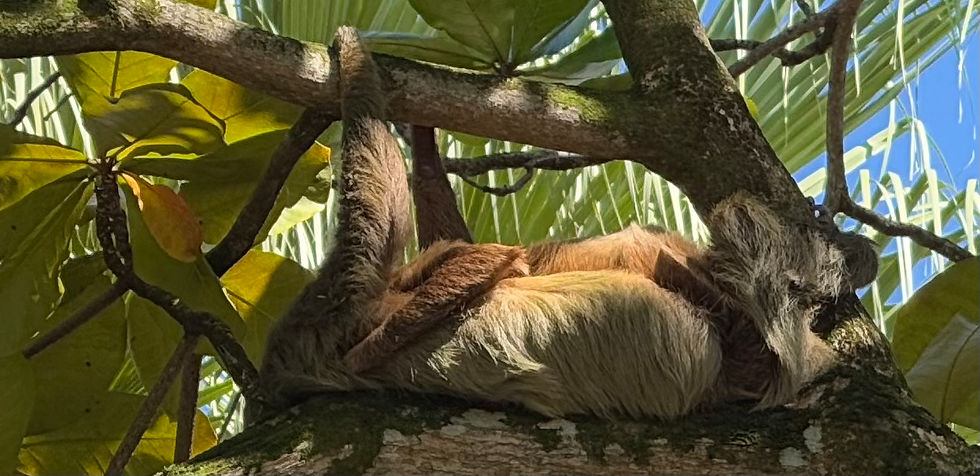
In Port Limón, Costa Rica, we took a stroll through Vargas Park and found a bashful mother with her baby. Sloths should be easy to photograph given the speed with which they move, but these two seemed to be camera shy.
And then came the Panama Canal! Oh my goodness!
I can’t begin to summarize all that needs to be said about the building of the Panama Canal. I recommend one of two things, if you’re interested. Either research the Canal and learn about its history and the politics involved; how long it took to build; how the Chagres River and countless tributaries were diverted to create Lake Gatun; how monster ships can’t fit; how many humans sacrificed their lives due to injury and illness; and how science and medicine overcame malaria carrying mosquitos. Or, take a cruise through the locks of the Panama Canal, traversing from the Atlantic Ocean to the Pacific Ocean, or vice versa. In one day!
We stood in the bow of our ship (considered one of the smaller ones by today’s standards) and watched it enter the first lock with less than twelve inches on either side. Land tugs (mules) guide each ship with constant pressure to ensure the distances are maintained and the ship arrives safely at the end of the third lock. The Canal consists of three locks at either end with Lake Gatun in the middle.
The crossing of Gatun Lake to reach the opposite ocean is slow and picturesque, as was the ascent and descent through the locks on each side. Our ‘guide’ for the day was a long-serving officer from the Panama Canal Authority. His knowledge and experiences intrigued all aboard.
The next day, we took another guided tour that involved being collected from the ship (docked in Panama City) by bus and taken for another speed boat tour, this time on Gatun Lake.
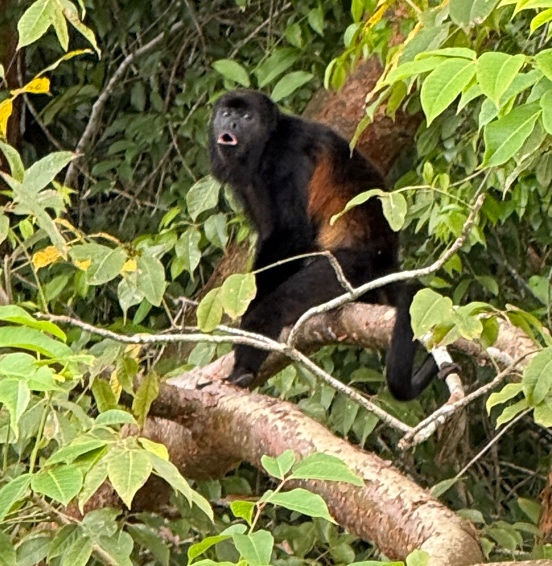
Because of the diversion of the Chagres River, villages had to be relocated. Much of the wildlife moved on as well. However, some didn’t. Three types of monkeys (White-Faced Capuchin monkeys, Mantled Howler monkeys and Geoffroy’s Tamarin monkeys), as well as bats, sloths, iguana, caimans, birds and snakes (including constrictors), and others, remained. As water levels rose, the remaining animals moved to higher ground. Eventually, what remained was a chain of small islands called Monkey Island. All else was submerged in the lake.
The Capuchin monkeys are cheeky and won’t hesitate to leap from an overhanging branch to the bow of a speedboat if they think there’s something intriguing onboard. The Howlers do, indeed, howl. The Tamarins seemed timid.


That evening, when we returned to the ship, we were invited to join the staff in the atrium for the lighting of the Christmas tree and the singing of carols. The turnout of guests, staff and crew was impressive. I was disappointed when I realized that I didn’t have my camera with me and missed the opportunity to share a glimpse of one of the larger events hosted onboard. However, I was able to return a while later and take photos of the creative Christmas display and the tree.
The following day, we crossed the equator enroute to Manta, Ecuador. Our tour that day took us to several locations, the highlight of which, for me, was Museo Ciudad Alfaro in Montecristi.The museum combines the history of the making of a hat known worldwide as the Panama Hatwith working illustrations of how the hats are made by hand.
Although the hats are made in Ecuador, the hat worn by American President Woodrow Wilson during the opening of the Panama Canal was erroneously named by media as a Panama Hat.
Our last tour in Ecuador took us to Guayaquil where we visited Hacienda El Castillo, a cacao plantation, boutique hotel and restaurant. After a tour along the tranquil paths of the plantation; a sampling of raw cacao beans removed directly from a cacao pod (the gooey mass must be sucked, not bitten) and freshly picked and portioned mango; we walked through the post-harvest cacao process and returned to the manor house where we were treated to a delicious, homemade lunch on the hotel’s patio. Dessert? You bet! Including a sampling of the chocolate produced by the onsite factory.
Overall, this was a fabulous cruise aboard Oceania Marina!
Happy Lunar New Year!


Comments